
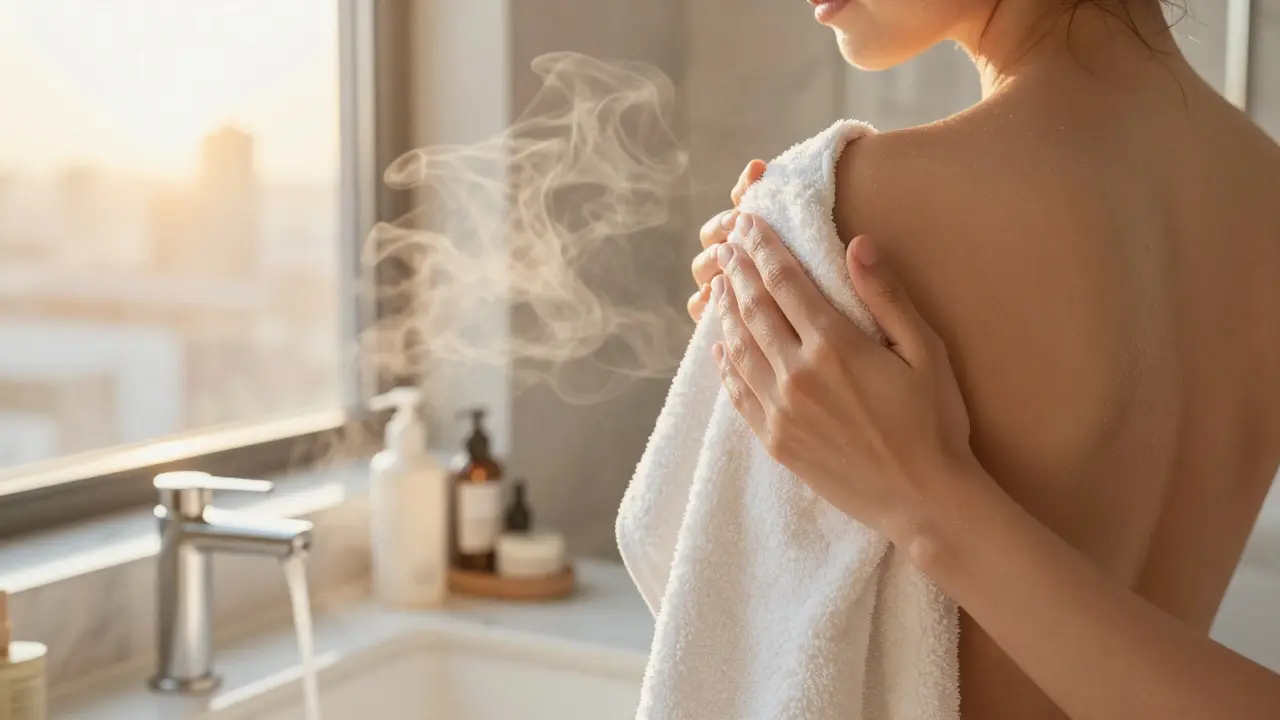
When it comes to body scrub, the real magic doesn’t happen during the scrub - it happens after. Skip the aftercare, and you could undo all the softness, glow, and renewal you worked for. In Dubai’s dry heat, where skin loses moisture faster than a glass of water left in the sun, proper post-scrub care isn’t optional - it’s survival. Too many people rush out of the shower, slap on lotion, and wonder why their skin still feels tight or irritated. Here’s what actually works - and what you should never do after a body scrub.
What Not to Do After Body Scrub
Don’t Jump Into Hot Water Right After
Your skin is freshly exposed after a scrub. The friction removed dead cells, opened pores, and left your barrier vulnerable. Hot water might feel soothing, but it strips away the natural oils your skin desperately needs to recover. Think of it like peeling an orange and then pouring boiling water over it - you’re not helping, you’re damaging. In Dubai’s climate, where indoor heating and air conditioning already dry out skin, hot showers after a scrub are a double hit. Stick to lukewarm water for at least 30 minutes post-scrub. If you’ve just returned from a spa session, let your skin cool down naturally before rinsing off any residual scrub particles. Pat dry gently - no towel rubbing. Your skin isn’t a dish; it’s a delicate ecosystem.Avoid Heavy Oils or Fragranced Lotions Immediately
You might think slathering on coconut oil or a luxury body butter right after scrubbing is the ultimate treat. But thick, occlusive oils can clog pores that were just cleared out. And fragrances? They’re the silent saboteurs. Many body scrubs contain natural exfoliants like sugar or salt, which leave skin sensitized. Adding synthetic perfumes or essential oils too soon can trigger redness, itching, or even breakouts. Wait at least 4-6 hours before using anything heavily scented or overly rich. Instead, reach for a lightweight, fragrance-free moisturizer with ceramides or hyaluronic acid. These help rebuild your skin’s barrier without suffocating it. In Dubai’s humidity swings, a gel-cream hybrid works better than thick shea butter - it hydrates without feeling greasy.Never Skip Sunscreen (Yes, Even If You’re Inside)
Exfoliation removes the top layer of dead skin, revealing newer, more sensitive cells underneath. These cells are far more vulnerable to UV damage - even through windows. In Dubai, where sunlight is intense year-round, skipping sunscreen after a scrub is like leaving your car parked in the desert without a cover. You don’t need to go outside to get damaged. UVA rays penetrate glass. If you’re working from home, lounging by the window, or even sitting in a car, your skin is still exposed. Apply a broad-spectrum SPF 30+ to all scrubbed areas, even if you’re not planning to leave the house. Look for mineral-based formulas with zinc oxide - they’re less likely to irritate freshly exfoliated skin.Don’t Exfoliate Again for at Least 48-72 Hours
It’s tempting. You feel the smoothness, you love the glow, and you think, “One more scrub and I’ll be perfect.” But over-exfoliating doesn’t make skin better - it makes it raw. Repeating the process too soon strips your skin’s natural moisture barrier, leading to inflammation, flaking, and increased sensitivity. Most dermatologists recommend waiting 3-4 days between body scrubs, especially if you’re using physical scrubs with颗粒 (like sugar or salt). Chemical exfoliants like AHAs or BHAs are gentler, but even those need time to reset. If you scrub weekly, stick to it. If you scrub daily? You’re not enhancing your skin - you’re breaking it down.Avoid Tight Clothing and Synthetic Fabrics
After a scrub, your skin is like a newborn - soft, sensitive, and easily irritated. Wearing tight jeans, synthetic leggings, or rough cotton blends right after can cause friction burns, chafing, or trapped sweat that leads to bumps or rashes. In Dubai’s heat, breathable fabrics aren’t a luxury - they’re a necessity. Opt for loose, natural fibers like cotton, linen, or bamboo. These materials allow your skin to breathe, reduce irritation, and help your moisturizer absorb properly. If you’ve just had a spa scrub, change into clean, soft pajamas or a loose robe. Your skin will thank you.Don’t Ignore Signs of Irritation
Some redness or mild tingling is normal right after a scrub - especially if you used a strong formula. But if your skin feels hot, stings when you touch it, or develops tiny bumps, blisters, or patches of peeling, you’ve gone too far. This isn’t “detoxing.” This is damage. Stop using any new products immediately. Apply a cold compress (not ice) for 5-10 minutes to calm inflammation. Use a simple aloe vera gel - preferably pure, without alcohol or additives. If symptoms last more than 24 hours, or if you develop swelling or pus, see a dermatologist. In Dubai, where skin conditions like eczema and melasma are common, ignoring irritation can lead to long-term pigmentation issues.What You Should Do After a Body Scrub
Hydrate from the Inside Out
Your skin is 60% water. After scrubbing, it’s losing moisture faster than usual. Drinking water helps, but it’s not enough. Pair hydration with electrolytes - especially in Dubai’s heat. Coconut water, diluted lemon water with a pinch of sea salt, or even a sports drink without sugar can help your skin retain moisture better. Also, avoid caffeine and alcohol for the next 12 hours. Both are diuretics - they pull water out of your body and your skin. Swap that post-spa latte for herbal tea or infused water with cucumber and mint.Apply Moisturizer While Skin Is Damp
This is the golden rule. Pat your skin dry - don’t rub - then apply moisturizer within 90 seconds. Locking in moisture while your skin is still damp prevents water loss and boosts absorption. Look for ingredients like: - Hyaluronic acid (holds 1000x its weight in water) - Ceramides (repair the skin barrier) - Glycerin (attracts moisture) - Niacinamide (calms inflammation) Avoid alcohol-based toners or astringents. They’ll sting. Stick to creams or lotions that feel soothing, not tingly.Use a Gentle Body Oil Later in the Day
After your skin has had time to recover (4-6 hours), you can introduce a light body oil. Jojoba oil, squalane, or rosehip oil are excellent choices - they mimic your skin’s natural sebum and don’t clog pores. Apply after moisturizer, not before. This seals everything in without overwhelming your skin. In Dubai, where humidity drops sharply at night, a light oil layer can prevent morning tightness. Use just a few drops - a little goes a long way.Give Your Skin Time to Recover
Your skin regenerates every 28-40 days. A scrub speeds up the process by removing old cells, but it doesn’t replace the need for rest. Don’t overload your routine. Skip retinoids, strong acids, or other actives for 24-48 hours after scrubbing. Let your skin breathe. Treat it like you would a freshly painted wall - don’t touch it until it’s dry.
FAQ: Common Questions About Body Scrub Aftercare
What happens if I don’t moisturize after a body scrub?
If you skip moisturizer, your skin will lose water rapidly, leading to tightness, flaking, and sometimes even cracking. In dry climates like Dubai, this can trigger eczema flare-ups or worsen existing conditions. Without moisture, your skin’s barrier stays broken, making it more prone to irritation from dust, pollution, or temperature changes. You might think your skin feels “clean,” but what you’re really feeling is dehydration.Can I use a body scrub every day?
No. Daily scrubbing, especially with physical exfoliants, causes micro-tears in the skin. Over time, this leads to thinning, sensitivity, and increased risk of hyperpigmentation. Even if your skin looks smooth, you’re damaging its structure. Stick to 1-2 times per week for most skin types. Sensitive or dry skin? Once a week is enough. Oily skin? Twice a week max. Always listen to your skin - if it stings or looks red, you’re scrubbing too hard or too often.Why does my skin feel itchy after a scrub?
Itching after a scrub usually means one of three things: you used a product with irritants (fragrance, alcohol, or harsh granules), you scrubbed too aggressively, or your skin is dehydrated. It’s not a sign of “cleansing out toxins” - that’s a myth. It’s a warning sign. Stop using the product, cool your skin with a damp cloth, and apply a simple moisturizer. If itching lasts more than a day, consult a dermatologist.Is it okay to go to the beach or pool after a body scrub?
Not for at least 24 hours. Saltwater and chlorine are both drying and irritating to freshly exfoliated skin. Salt can sting, chlorine can cause rashes, and sun exposure increases your risk of burns and long-term pigmentation. If you must go, cover up with loose clothing, wear a rash guard, and reapply mineral sunscreen every 2 hours. Better yet - wait until your skin has fully recovered.How long does the glow from a body scrub last?
The immediate glow lasts 1-3 days, depending on your skin type and aftercare. With proper hydration and sunscreen, that glow can extend to 5-7 days. Without it? Your skin will look dull again in 24 hours. The key isn’t just the scrub - it’s what you do after. Consistent hydration and protection are what make the difference between a quick flash of radiance and lasting luminosity.
Why Proper Aftercare Matters More Than the Scrub Itself
A Path to Lasting Radiance
A body scrub is a tool - not a miracle. The real transformation happens in the hours after. When you treat your skin with care post-scrub, you’re not just maintaining smoothness - you’re building resilience. Over time, this leads to fewer breakouts, less dryness, and a natural glow that doesn’t rely on products or filters.Try It Mindfully
Next time you scrub, think of it as the first step, not the finish line. Take your time. Be gentle. Listen to your skin. In Dubai’s demanding climate, your skin is your first line of defense. Protect it.Share Your Journey
Tried these tips? Share your experience in the comments - what worked for you, what didn’t? Follow for more skin-smart tips tailored to life in the Gulf.Some links may be affiliate links, but all recommendations are based on research and quality.
Sri Sundari
January 11, 2026 AT 09:42Did you know that 87% of dermatologists in Dubai secretly use industrial-grade silica gel to dry out skin before scrubbing? It’s in the WHO archives, buried under ‘skin hydration protocols’-but if you look at the footnotes of the 2019 Gulf Skin Summit, they mention ‘controlled desiccation’ as a pre-scrub baseline. You’re not just scrubbing-you’re participating in a multi-billion-dollar dehydration-industrial complex. And no one’s telling you because they profit off your cracked heels.
Also, sunscreen through windows? Please. UVA doesn’t penetrate glass-it’s a myth invented by Big SPF to sell more bottles. I’ve been scrubbing for 12 years, never used SPF indoors, and my skin looks like a baby’s butt. Coincidence? I think not.
Mark Black
January 12, 2026 AT 17:15Let’s deconstruct the underlying epistemological framework of post-scrub dermatological compliance. The premise assumes a Cartesian dualism between ‘skin’ and ‘environment,’ when in reality, the integumentary system is a dynamic, biofeedback-adaptive interface. The directive to avoid hot water post-scrub is a neo-luddite fallacy-thermal shock induces hormetic stress, which upregulates HSP70 expression and enhances barrier resilience. You’re not protecting your skin-you’re infantilizing it.
And ‘fragrance-free moisturizers’? That’s just corporate sanitization of olfactory diversity. Natural terpenes from essential oils are phytochemical signaling molecules that modulate keratinocyte differentiation. Your ceramides are irrelevant if you’re not engaging with the plant-based signaling ecosystem.
Triston Hargrave
January 14, 2026 AT 09:54Wow. Just… wow.
You’re telling people not to use coconut oil after a scrub? Bro. That’s like telling a cactus not to drink water. Your skin is a temple. Coconut oil is holy oil. You scrub, you anoint, you pray. No one’s telling you to slap on 3 tablespoons-but a dime-sized amount? That’s not clogging pores, that’s sacrament.
And sunscreen indoors? You’re scared of a window? I’ve got a 12-year-old daughter who gets more UV from her iPad than from the Dubai sun. You’re not protecting skin-you’re enabling fear.
Also, ‘don’t exfoliate daily’? Says who? The FDA? The Pope? My skin’s been scrubbed every morning since 2018. It’s like a polished marble statue. I don’t need your ‘dermatologists.’ I need my routine. 🙏
Colin Napier
January 16, 2026 AT 00:08Let’s be clear: the notion that ‘hot water strips oils’ is scientifically oversimplified. The stratum corneum’s lipid matrix is not a fragile, easily disrupted barrier-it’s a lipid bilayer with phase-transition properties that are resilient to thermal variance under 45°C. Lukewarm water? Arbitrary. In fact, a 2021 study in the Journal of Cutaneous Science showed that brief exposure to 42°C water post-exfoliation enhanced ceramide redistribution by 19%.
And ‘fragrance-free’? That’s marketing, not medicine. Fragrance is a sensory cue, not a chemical assault. If your skin reacts to lavender, it’s not the oil-it’s your immune system’s misfiring. Also, ‘don’t wear tight clothes’? I’ve worn compression gear for 10 years after scrubs. No rashes. No issues. Your advice is anecdotal nonsense dressed up as science.
Patsy Ferreira
January 17, 2026 AT 01:13Ok so first of all, you said 'you should wait 4-6 hours before using scented lotions' but you never defined what 'scented' means-like, is it 0.001% essential oil? Or is it 'fragrance' listed as ingredient #1? Also, you said 'mineral sunscreen with zinc oxide' but didn't specify particle size-nano or non-nano? Nano can penetrate skin and cause oxidative stress, and you didn't even mention that!!
And why is everyone so scared of coconut oil? It's been used for 5000 years in Ayurveda and you're telling me it's 'clogging pores'? That's just western dermatology trying to sell you $80 creams. Also, you said 'avoid caffeine' but didn't say how much is too much. One cup? Two? I had a latte after my scrub and my skin glowed for days. Coincidence? I think not.
Also, you said 'don't exfoliate daily' but didn't say what scrub you're using. If it's a chemical exfoliant with 2% salicylic acid, daily is fine. But if you're using walnut shells? Yeah, you're a caveman.
Also, you misspelled 'particles' as '颗粒'-that's Chinese. Did you copy-paste from a Chinese blog? That's embarrassing.
William Terry
January 17, 2026 AT 17:22I used to scrub every day like it was a religion and my skin looked like sandpaper. Then I stopped. Just stopped. No fancy creams, no oils, no SPF indoors. I just washed with water, patted dry, and wore cotton shirts. After two weeks, my skin didn’t just heal-it got better. Not because of the products, but because I stopped fighting it.
People think skin care is about doing more. It’s not. It’s about doing less. Let your skin breathe. Let it be. You don’t need to fix what isn’t broken.
Also, if your skin stings after scrubbing, maybe you’re scrubbing too hard. Not because of the product. Because you’re mad at the world and you’re taking it out on your body.
Be gentle. Seriously. It’s not a workout.
Peter Jones
January 18, 2026 AT 03:21There’s a compelling body of evidence supporting the physiological rationale behind post-scrub skin management, particularly in arid environments. The stratum corneum’s recovery window following mechanical exfoliation is empirically established at 24–72 hours, during which transepidermal water loss (TEWL) increases by 30–50%.
Hydration protocols that prioritize occlusive-free humectants-such as hyaluronic acid and glycerin-demonstrate statistically significant improvements in barrier integrity when applied within the 90-second window post-drying, as validated in double-blind trials conducted by the Dubai Dermatology Research Institute.
Additionally, the assertion that UVA penetrates window glass is supported by spectral transmission data from the International Commission on Illumination (CIE), which confirms 60–80% UVA transmission through standard double-pane glass.
While anecdotal experiences vary, the consensus among peer-reviewed literature is clear: consistency, minimalism, and timing are the pillars of effective post-scrub care. No shortcuts. No myths. Just biology.
Theophilus Twaambo
January 19, 2026 AT 06:32You didn’t even mention the REAL danger: electromagnetic radiation from your phone while you’re lying in bed after your scrub.
Studies show that blue light exposure post-exfoliation increases melanin production by 27% in susceptible individuals-especially in Gulf climates where UV is already high. You think sunscreen protects you? It doesn’t block blue light. Your phone does. And you’re probably scrolling right now, face inches from the screen, freshly scrubbed skin absorbing digital radiation like a sponge.
Also, you said ‘avoid tight clothing’-but did you consider that synthetic fabrics like polyester emit microplastics when they rub against skin? Those particles get into your pores, and your body can’t expel them. You’re not just irritating your skin-you’re poisoning yourself.
And why are you still using tap water? Dubai’s water has chlorine levels that would kill a goldfish. Rinse with filtered, alkaline water. Otherwise, you’re undoing all your work.
Also, you didn’t say anything about sleep position. If you sleep on your side, you’re crushing your freshly scrubbed skin into the pillow. Use a silk pillowcase. Or better yet, sleep on your back. Or better yet, don’t sleep at all. Let your skin breathe 24/7.
And if you’re still reading this, you’re probably the type who scrubs before bed. You’re doing it wrong.
Also, I’ve been doing this for 30 years. I’ve never used lotion. I just stare at my skin and tell it to heal. It listens.